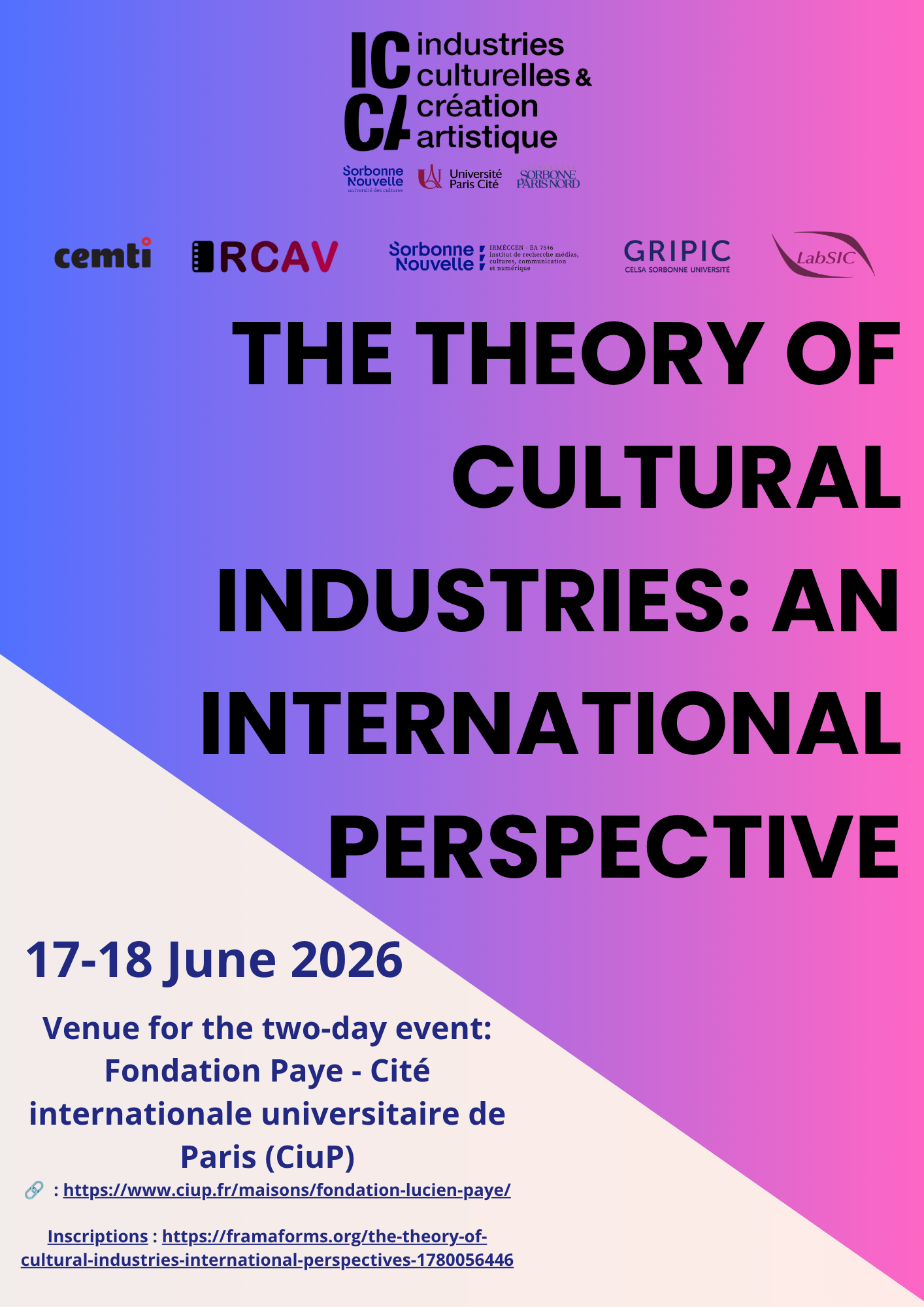
Dates: 17-18 June 2026
Venue for the two-day-event: Fondation Paye – Cité internationale universitaire de Paris (CiuP)
Aims and Organisational Principles
This event aims to bring together French-language research and the perspectives of international researchers who have also drawn inspiration from the English- and Spanish-speaking strands of cultural industries theory. The conference is structured around four sessions, each addressing a different theme:
– The links between creation and industry
– Concentration and financialisation
– The challenges of territorialisation and transnationalisation
– The industrial and regulatory challenges of innovation
The conference will be held in English
Research question
The ‘theory of cultural industries’, a tradition within the political economy of communication, has documented changes in culture and communication for over 40 years. By highlighting the links between socio-economic production logic, technical innovation and the symbolic dimension, and situating these within the framework of financialised capitalist strategies, the theory offers a critical approach to the media that is attentive to the challenges they have faced since the end of the 20^(th) century. However, while it is an essential approach within French communication sciences, this conference will examine its international reception. The aim is to review the theoretical and methodological contributions of cultural industries theory by exploring how it has been received and adapted in different geographical contexts. The conference will also examine its relevance in the face of new challenges (platformisation, artificial intelligence, etc.) by revisiting the specific way in which it proposes to address traditional media issues (concentration, transnationalisation, cultural policies, discourse on the ‘information society’, etc.). In this context, the agenda will include environmental sustainability issues, particularly those relating to extractivism (the extraction of resources such as minerals) and the energy consumption of artificial intelligence platforms and systems in terms of their operating conditions (e.g. server cooling) and end use. Finally, the expectations surrounding media pluralism, creation and innovation vary across different countries. The diversity of situations and challenges in various geographical areas, such as Canada, Spain and the United Kingdom, will be addressed. The film and audiovisual sectors are directly affected. They constitute some of the most significant cultural industries. Contemporary challenges such as platformisation and the deployment of artificial intelligence have a significant impact on cinema and the audiovisual sector. Similarly, the theory of cultural industries enables a dialogue to be established with Film and Audiovisual Studies by approaching industrial issues without separating them from their cultural, symbolic and political aspects.